
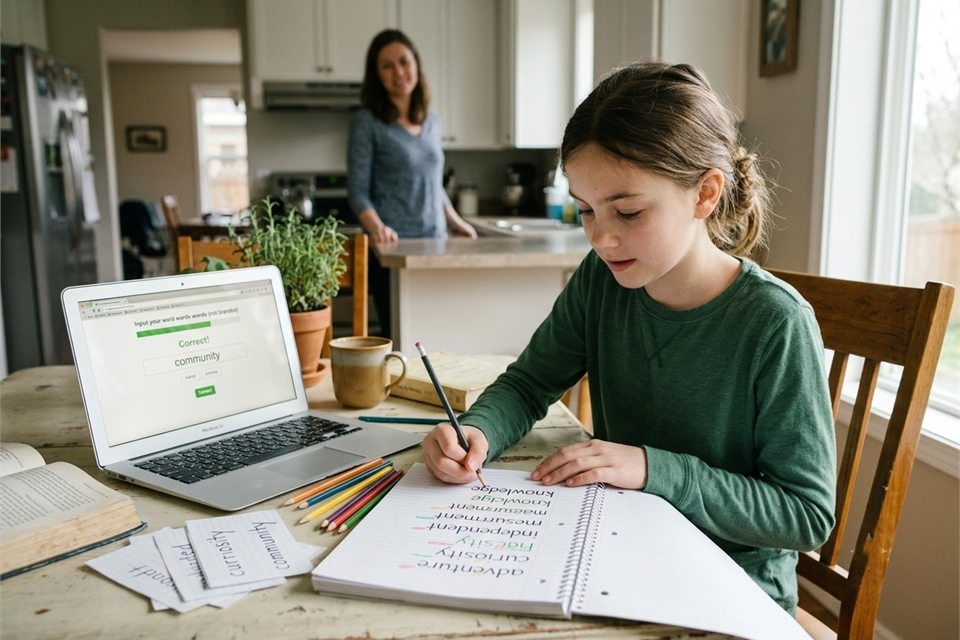
Searching for a kindergarten homeschool curriculum can make a simple question feel enormous. One program promises phonics. Another has readers, handwriting, games, videos, worksheets, and hundreds of lessons. Then a parent with a four-year-old and a five-year-old has an extra problem: the children may be close in age but ready for very different things.
A more useful starting question is not "Which program has the most pieces?" It is "What does my child need to learn next in order to become a reader?" Once that sequence is clear, it becomes much easier to decide whether you need a complete curriculum, a simple phonics program, library books, printable practice, or just a flexible way to reinforce the exact words and patterns already being taught.
What actually matters in kindergarten reading?
The U.S. Department of Education's What Works Clearinghouse groups foundational reading into four broad recommendations: develop academic language and vocabulary, connect the sound structure of speech to letters, teach children to decode and analyze words, and make sure children read connected text. The guide rates the sound-to-letter and decoding recommendations as supported by strong evidence, and connected-text reading as supported by moderate evidence.
For families, that translates into a much less intimidating list. You are not trying to recreate an elementary school in your dining room. You are trying to make sure the important parts are present and that the next lesson grows from what the child can already do.
A practical order for teaching reading at home
Think of this as a progression rather than a rigid staircase. Children keep listening to stories while learning letters. They keep practicing sounds while beginning to decode. They keep decoding while learning a small number of high-frequency words. The sequence tells you what to emphasize, not what you must stop doing.
1. Build language and a reason to care about books
Read picture books, stories, poems, and simple nonfiction aloud. Talk about what happened, what a new word means, what a character might do next, or how a picture connects to the text. This is not "extra" time that sits outside reading instruction. The IES foundational skills guide includes academic language and vocabulary as one of its four recommendations, and its family resources explicitly use conversation during read-alouds to build vocabulary and knowledge.
For a preschooler, this may be the center of the reading day. For a kindergartener who is already sounding out words, keep it anyway. A child's independent reading level should not limit the ideas, stories, and vocabulary they can encounter with an adult.
2. Play with the sounds inside spoken words
Before print becomes useful, children need to notice that spoken words can be broken into parts. Start with skills such as rhyming, syllables, and beginning sounds when those are appropriate, then move toward the phoneme level: hearing, blending, segmenting, and changing individual sounds.
Phonological awareness is about sound, not printed letters. Reading Rockets describes phonemic awareness as the more advanced part of phonological awareness: working with the individual sounds in spoken words. That distinction matters because a child can know many letter names and still find it hard to blend /m/ /a/ /p/ into map.
3. Connect those sounds to letters
Now make the bridge to print. Teach letter names and the common sounds the letters represent. The goal is not a giant flash-card performance. The useful knowledge is being able to look at a printed letter or spelling and connect it with the sound needed to read or write a word.
The Common Core kindergarten foundational skills standards, one useful reference point rather than a homeschool law or universal curriculum, include print concepts, upper- and lowercase letter recognition, letter-sound correspondences, vowel sounds, phonological awareness, high-frequency words, and emergent-reader text.
4. Blend to read and segment to spell
Once a child knows enough sound-letter relationships, use them in words. For a simple CVC word such as map, the child can look from left to right, say the sounds, and blend them into the whole word. In the other direction, the child can hear map, segment it into sounds, and choose letters to spell it.
Reading and spelling strengthen the same sound-print connection from opposite directions. If your curriculum teaches a new sound pattern, include both reading and simple encoding rather than keeping spelling completely separate.
5. Move into simple decoding before chasing big word lists
Use words that mostly contain sound-spelling relationships the child has already been taught. Early CVC words are a common place to begin because the child can practice the full process of looking through the word, saying the sounds, and blending them.
When the child guesses from the picture or the first letter, bring attention back to the print. Our guide on helping a child decode unfamiliar words gives a simple prompt sequence for this moment.
6. Teach useful high-frequency words without making them the whole plan
Children will meet some words constantly. Some can be decoded using patterns they know; others contain a part that is not yet predictable for the child. Teach these words explicitly and in context, but do not let a long sight-word list replace phonics and decoding.
If a child seems to know a sight word one day and lose it the next, see Sight Words Not Sticking? for a smaller review routine built around the words that actually need another pass.
7. Read connected text and keep writing
Word cards are useful, but reading is not a pile of isolated words. Give the child chances to read short connected text that lets them apply the patterns they have learned. The IES practice guide recommends connected-text reading every day to support accuracy, fluency, and comprehension.
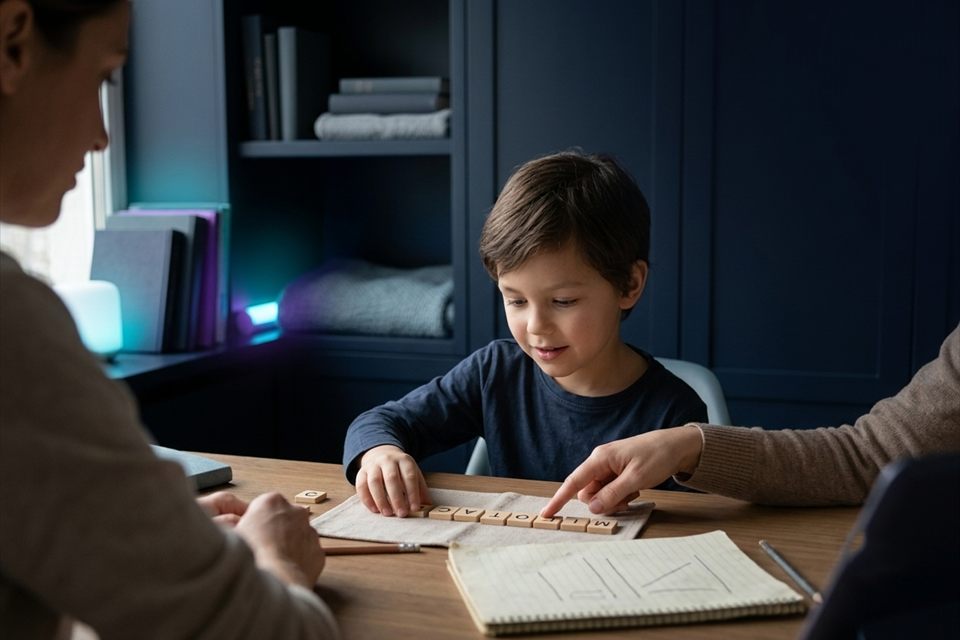
Keep writing in the picture too. A child can label a drawing, write a simple sentence with help, build a word with letter tiles, or spell a few words from sounds. Early writing gives you useful information about which sound-letter connections are becoming secure.
Keep the curriculum. Practice the exact skill being taught.
WordyKid can be used as a flexible practice layer around your child's real material: a short word list, a reading page, worksheet, sight words, or words from a book.
Practice these words on WordyKidAges 4, 5, and 6 can look very different
Age can help you choose an entry point, but it should not become a deadline. A four-year-old who loves letters may be ready to blend simple words. A five-year-old may still need a great deal of oral sound work. A six-year-old may decode accurately but need more practice reading connected text. Use the child's current skill, not the birthday alone, to choose the next step.
| Stage | Useful emphasis | What it can look like at home |
|---|---|---|
| Preschool / around 4 | Language, books, rhyme, syllables, beginning sounds, letter curiosity | Read aloud, talk about pictures and ideas, clap names, notice signs, match a few letters to sounds, use magnetic letters or objects in play. |
| Early kindergarten / around 5 | Phonemic awareness, letter-sound knowledge, blending, segmenting | Build and read simple words, stretch words into sounds, write letters for sounds, read very short controlled text. |
| Later kindergarten / around 5-6 | More secure decoding, spelling, high-frequency words, connected text | Read short books and sentences, write simple messages, review missed words, keep adding sound-spelling patterns in a planned sequence. |
These are examples, not diagnostic cutoffs. The IES family resources explicitly encourage families to choose activities based on the child's understanding and to set aside an activity that is too difficult rather than turning practice into frustration.
What you actually need for kindergarten homeschool reading
You can spend a great deal on early reading materials, but the essential list is surprisingly short. A complete program is useful when it gives you structure you would otherwise have to build yourself. It is not automatically better because it has more components.
- A clear sequence for foundational skills. You need to know which sound-letter relationships and word patterns are being taught now and what comes next.
- Books for adults to read aloud. Library books are enough. Choose stories and informational books that create conversation, vocabulary, curiosity, and enjoyment.
- Text the child can actually practice reading. Early readers need material that gives them a fair chance to use the sound-spelling patterns they have learned.
- Something to build and write words with. Pencil and paper, a small whiteboard, magnetic letters, or simple letter cards can all work.
- A way to review the words and patterns that are not secure yet. This can be homemade cards, a notebook, a game, or a digital practice tool. The important part is that practice follows the child's real instruction rather than replacing it.
How to choose a kindergarten homeschool reading curriculum
A curriculum should make the teaching sequence easier to follow. It should not require you to reverse-engineer the reading science from a box of activities. Before buying, look for answers to these questions.
- Is the sequence explicit? Can you tell which skills are taught first, how new skills build on earlier ones, and what the child is expected to practice?
- Does it connect spoken sounds to print? Look for phonological and phonemic awareness together with letter-sound instruction, not one in isolation.
- Does the child practice blending, segmenting, reading, and spelling? These should appear as active tasks, not only videos or recognition games.
- Does reading material match what has been taught? A beginning reader needs chances to apply taught patterns in actual words and connected text.
- Is there review without endless repetition? A useful system helps you revisit insecure skills while allowing secure ones to move forward.
- Can you use it with the child you actually have? If the pacing, amount of seatwork, or parent preparation makes the program hard to sustain, a theoretically excellent curriculum may still be a poor practical fit.
If you already own a curriculum that gives you a sensible instructional sequence, you may not need to replace it. Keep the structured teaching and add flexible practice around the exact material. That is often a cleaner solution than starting over with another full program.
A simple homeschool reading routine
There is no single research-prescribed lesson length that fits every four-, five-, or six-year-old. For home use, it is often easier to think in short blocks with one clear job each. The example below is a practical routine, not a required schedule.
- Sound work: blend, segment, rhyme, or manipulate spoken sounds at the level your child is learning.
- Phonics and word building: teach or review one small set of sound-letter relationships and use them in words.
- Read connected text: use a short passage or book that gives the child a chance to apply those skills.
- Write something: a word, label, sentence, or short message using sounds and spellings the child knows.
- Read aloud together: keep this enjoyable and broader than the child's independent reading level.
You can split these across the day. A preschooler may spend far more time in conversation, books, songs, and playful sound activities. A kindergartener who is ready to decode can have a more explicit skill block while still sharing the same family read-aloud.
Homeschooling a preschooler and kindergartener together
This is where many families accidentally create twice the work. You do not need two completely separate literacy days. Share the parts that naturally work across ages and separate only the skill instruction that needs to be different.
Read the same picture book together. Talk about the story together. Go on the same letter or word hunt around the house. Then give the preschooler a playful task such as finding objects that start with /m/ while the kindergartener builds and reads words such as map, mat, and man. The theme can be shared even when the reading demand is not.
This is also a natural place for photos, signs, menus, toys, and favorite books. A younger child can name and sort real objects. An older child can connect those same objects to printed words, sounds, simple sentences, or spelling.
Where WordyKid fits - and where it does not
WordyKid is best used here as a practice and enrichment layer, not as the complete kindergarten homeschool curriculum. Keep a structured source for teaching the reading sequence. Then use WordyKid when you want to practice the exact material already in front of the child: words from a phonics lesson, sight words, a worksheet, a reading page, a favorite book, or words taken from everyday objects and photos.
That distinction is useful with young children. A preschooler can use a parent-led activity built from familiar pictures and objects. A kindergartener can practice CVC words, sight words, early reading material, or a short list from the current lesson. The tool can change the practice format without changing what you decided to teach.
Use today's lesson instead of buying another practice set
Bring the words or reading material your child is already using and turn that material into short practice games.
Start a practice roundHow to know what to teach next
Watch the process, not only whether an answer was right. A child who reads map instantly and a child who guesses map from the picture may produce the same answer for very different reasons.
- If the child cannot hear or blend the sounds, return to oral phonemic awareness at an easier level.
- If the child can blend sounds orally but cannot connect them to print, review the relevant letter-sound relationships.
- If the child can read a pattern in isolated words but not in a sentence, add short connected-text practice.
- If the child reads a word but cannot spell it, add segmentation and encoding with the same sound-spelling pattern.
- If the child can do the skill accurately, reduce unnecessary repetition and move forward while reviewing it briefly later.
Persistent or significant difficulty deserves a conversation with an appropriate teacher, reading specialist, or other qualified professional. An online practice tool can give a child more chances to work with selected words, but it cannot determine the cause of a reading difficulty.
Kindergarten homeschool reading questions
What should I teach for kindergarten homeschool reading?
Build language through read-alouds and conversation, develop phonological and phonemic awareness, teach letter-sound relationships, practice blending and segmenting, move into simple decoding and spelling, teach useful high-frequency words, and give the child regular practice with connected text.
Do I need a complete kindergarten reading curriculum?
Not necessarily. You do need a coherent instructional sequence. A complete curriculum can provide that structure, but a simpler phonics sequence plus books, writing, and appropriate practice can also work when the parent is comfortable organizing the pieces.
What order should I teach reading at home?
A useful progression is oral language and print awareness, phonological awareness, letter-sound knowledge, phoneme blending and segmenting, simple decoding and spelling, high-frequency words, and increasingly connected reading. Keep reviewing earlier skills as new ones are added.
Should a preschooler and kindergartener use the same reading program?
They can share read-alouds, songs, rhymes, conversation, and playful literacy activities. Their explicit skill work can be different. The preschooler may need more oral sound play and letter exploration while the kindergartener may be ready for systematic decoding and spelling.
How long should kindergarten homeschool reading lessons be?
There is no single lesson length that is right for every child. Keep focused skill work short enough for accurate participation, use more than one brief activity when that works better, and keep relaxed read-aloud time separate from drill or correction.
The bottom line
A kindergarten homeschool reading plan does not have to be huge. Give your child rich language and books, teach how spoken sounds connect to letters, practice blending and segmenting, read and spell simple words, add useful high-frequency words, and keep moving into connected text.
Choose a curriculum because it gives you a clear teaching sequence, not because it gives you the most pages. Use simple materials for instruction, library books for language and knowledge, and flexible practice for the exact words and patterns that need another round. That is enough structure to make the next decision without trying to buy your entire homeschool journey on day one.
Sources and further reading
- Institute of Education Sciences - Foundational Skills to Support Reading for Understanding in Kindergarten Through 3rd Grade
- Institute of Education Sciences - Supporting Your Child's Reading at Home
- Reading Rockets - Phonological and Phonemic Awareness
- Reading Rockets - Phonics and Decoding Activities for Kindergarten
- Common Core State Standards Initiative - Kindergarten Reading Foundational Skills
- WordyKid Editorial Standards