
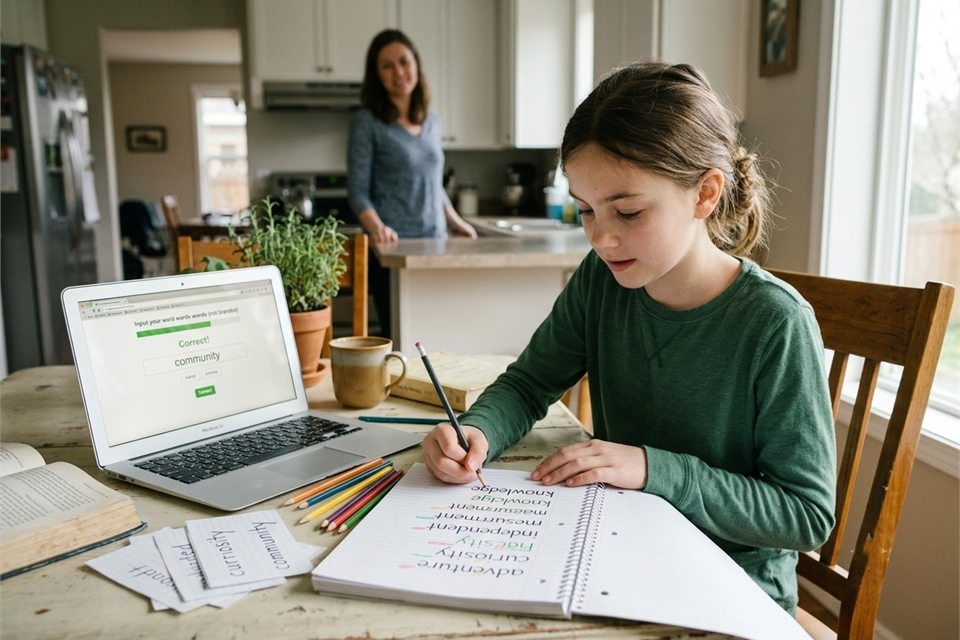
If spelling practice has become a struggle, adding another workbook or full program may not solve the problem. Many homeschool parents already know which words need attention: words missed in a lesson, longer words guessed while reading, vocabulary from a unit study, or spellings that keep appearing incorrectly in their child's writing.
A useful supplement should help you practice those exact words without creating another lesson to plan. Homeschool spelling games can add variety, but the learning goal should remain clear. Your child still needs to notice sounds and spelling patterns, recall the spelling without seeing it, and check the result.
A practical place to start
Begin with three to eight words that caused a pause, guess, or spelling error. Choose one short activity that focuses on a useful pattern, word part, meaning, or retrieval. Hide the correct spelling for part of the activity, check the result immediately, and carry only the missed words into the next round.
This approach works with a boxed curriculum, an eclectic plan, unit studies, online classes, tutoring, library books, or lessons you create yourself. You do not need a separate spelling system every time attention drops. Use the words already inside the learning your child is doing.
Keep your curriculum. Practice the words causing trouble.
Add the exact words from today's lesson, book, or writing and turn them into short WordyKid practice games.
Practice this word listStart with the words already causing trouble
A weekly spelling list is only one source for homeschool spelling practice. The most useful words are often the ones that interrupted a real lesson, appeared repeatedly in writing, or caused your child to pause, guess, or ask for help.
- Phonics or spelling: words that use the sound or spelling pattern currently being taught.
- Reading: unfamiliar words your child guessed, skipped, or could not blend while reading a book or article.
- Writing: words your child wants to use but still asks you to spell, avoids, or writes differently each time.
- Science, history, and unit studies: key vocabulary that needs to become easier to read, spell, and explain.
- Foreign language lessons: a small set of current words that needs more recognition, pronunciation, or recall.
Keep the list small enough to reveal a pattern. Three to eight connected words can show whether the difficulty involves a vowel pattern, an ending, a word part, meaning, or simple retrieval. That gives you a clearer next step than assigning a long list of unrelated difficult words.
Eight homeschool spelling games using your own word lists
Choose the activity that matches the problem you are seeing. You do not need to complete all eight, and you do not need to turn every lesson into a game. One focused activity with a small word list is enough for a useful practice round.
1. Sort by spelling pattern, word part, or meaning
Write the words on cards and ask your child to create groups. The rule might involve a vowel pattern, ending, prefix, suffix, syllable count, part of speech, or subject. Ask your child to explain one choice. The explanation shows what they noticed and helps you see whether the pattern is understood.
2. Build a word and change one part
Build one word with letter tiles, magnetic letters, or paper squares. Change one sound, spelling pattern, prefix, suffix, or base to make a related word. Read both words and describe exactly what changed. This is most useful when the words share a feature your child has already been taught.
3. Cover the word and retrieve the spelling
Let your child study one word, say it, and identify the part that may be difficult to remember. Cover the word and ask for one complete spelling attempt. Reveal the model, compare from left to right, and correct the specific difference before trying again later.
4. Compare spellings that keep changing
If the same word appears differently across writing assignments, place two attempts beside the correct form. Ask what stayed the same and which part changed. Then hide the examples and try the word once more. This turns a vague spelling problem into a specific part that can be practiced.
5. Break a longer word into useful parts
For a longer word, look for a familiar prefix, suffix, base word, spelling pattern, or syllable division. Read the parts, combine them, and then write the whole word. Do not ask your child to guess from the first few letters. The final word should match every part of the printed word.
6. Use the word in two different contexts
Ask your child to use the same word in two sentences, explanations, or subject examples. This is especially useful for vocabulary from literature, science, and history. Check both the meaning and the spelling so the activity does not become sentence writing with the target word still uncertain.
7. Find the word or pattern in real reading
Search for the target word, a related word, or the same spelling pattern in the book, article, worksheet, recipe, or lesson already being used. Discuss what makes the example related. Then return to the original word and read or spell it without looking.
8. End with a short mixed review
Say three to eight words in a different order from the original list. Use a sentence when the meaning could be unclear. Your child writes without seeing the words, checks immediately, and keeps only the missed words for the next round. Secure words do not need to be repeated simply to make the activity longer.
Keep practice age-appropriate for older learners
A child who is ten, eleven, or twelve may still need support with spelling or decoding, but the practice should not look as though it was designed for a much younger child. Use age-appropriate words, examples, images, and challenges while keeping the learning step manageable.
Choose words from novels, science, geography, history, technology, hobbies, or your child's own writing. Let your child help decide which words deserve another round. A short challenge, a choice of activity, or removing mastered words from the list can feel more respectful than rewards aimed at very young learners.
When longer words are being guessed, teach or point out a useful structure before beginning the game. Identify a prefix, suffix, base word, familiar spelling pattern, or syllable boundary. Practice can strengthen a strategy that has been explained, but a game should not pretend to teach an unfamiliar pattern on its own.
A flexible four-session homeschool spelling routine
- Session 1: Collect three to eight words from real lessons, reading, or writing. Read them and identify what connects them or why each one was selected.
- Session 2: Teach or review the difficult pattern, sound, word part, or meaning using direct examples.
- Session 3: Use one short game with the same word set. Stop when the planned round is complete rather than waiting for attention to disappear.
- Session 4: Complete a delayed mixed review without showing the list. Remove secure words and keep only the words that still need support.
These sessions can happen on consecutive days or whenever they fit your week. The useful sequence is simple: identify the problem, teach what is needed, practice briefly, and check again after a delay.
Already have a worksheet, list, or lesson page?
A photo may be faster than typing an entire page. Upload a printed curriculum page, worksheet, or clear handwritten list, review the extracted words, remove anything that does not belong, and keep the exact words you want to practice.
The review step matters because handwriting, page layout, lighting, and background text can affect extraction. You can also paste a word list directly when that is simpler. The goal is to reuse the lesson material you already have, not create another assignment.
Turn a homeschool lesson page into short practice
Upload a photo instead of typing the whole page, then review and edit the extracted words before practice begins.
Upload a lesson pageWhat often makes homeschool spelling practice harder
Avoid introducing a new app, printable, and activity every time attention drops. Constant novelty can create more preparation for the parent without making the learning target clearer. Keep the word set stable and change one practice action at a time.
Avoid making speed or guessing the goal. A word that fits the topic is not necessarily the word printed on the page. Ask your child to look through the whole word and check whether the answer matches all of its letters and useful parts.
Avoid leaving the correct spelling visible throughout every game. Recognition is useful, but the child also needs an opportunity to retrieve the spelling without the model. Keep the attempt brief and check it calmly rather than turning every round into a test.
Finally, do not treat a game as an assessment or diagnosis. If your child repeatedly guesses, cannot apply familiar letter-sound relationships, struggles across many types of words, or becomes significantly distressed, save specific examples and discuss them with an appropriately qualified teacher or specialist.
How WordyKid fits into a homeschool plan
WordyKid is a supplemental practice tool. It can help your child revisit a selected word list in different formats, but it is not a complete homeschool language arts curriculum, a reading intervention, or a diagnostic service.
Its role is specific: take the words that genuinely need attention and make a focused practice round easier to begin. Those words may come from a spelling lesson, unit study, difficult chapter, foreign language lesson, or your child's own writing.
You remain in control of the learning goal and the word list. The games provide another way to practice the material chosen by your family, tutor, or curriculum.
Questions homeschool parents ask
Can I use my own spelling words in homeschool games?
Yes. You can use words from any homeschool curriculum, book, worksheet, online class, unit study, writing assignment, or subject. A small list connected to the current lesson is usually easier to practice well than a long collection of unrelated words.
Are spelling games a complete homeschool language arts curriculum?
No. Spelling games can support practice, but they do not replace explicit instruction, connected reading, writing, feedback, or a complete language arts plan.
Can older homeschool students use spelling games?
Yes. Choose age-appropriate words and examples from literature, science, history, technology, foreign languages, hobbies, or the student's own writing. The practice can remain focused without looking childish.
How long should homeschool spelling practice take?
A focused five- to ten-minute round is a practical starting point, not a strict rule. Use a small word set, finish with a no-look check, and stop when the planned round is complete.
What if my child guesses at unfamiliar words?
Direct attention back to the printed word. Look through the whole word, identify familiar parts, connect letters and sounds, blend, check the result, and reread the sentence. Save difficult words for a short practice round after reading instead of interrupting every line with a separate game.
The bottom line
You may not need another curriculum to improve spelling practice. Start with the program, book, worksheet, or lesson already open. Choose a small set of words that caused a real problem, teach the pattern or meaning that needs attention, practice briefly, and check the words again after a delay.
The curriculum remains the source of instruction. The game supports that instruction by giving your child another focused way to return to the words.