
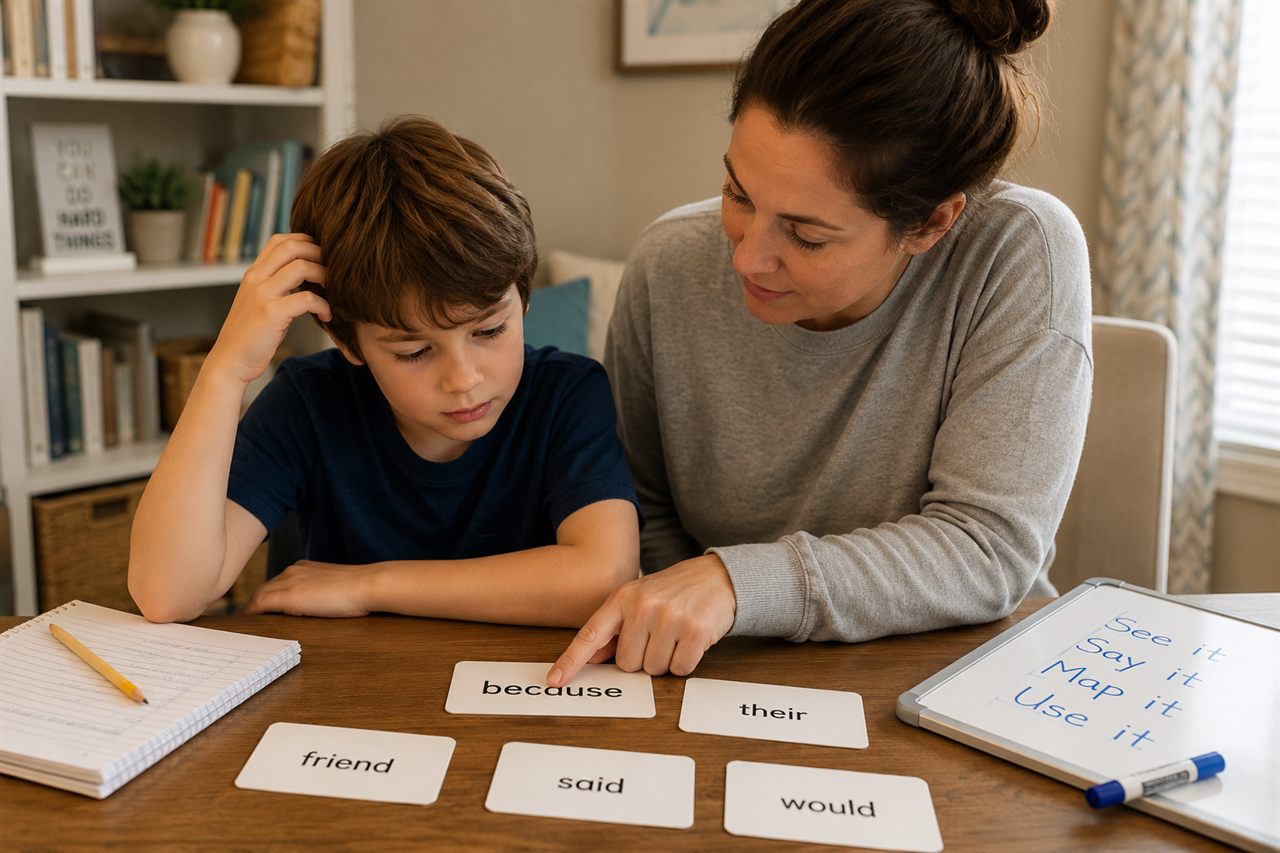
Your child reads because correctly tonight. Tomorrow, they look at it as if they have never seen it before. Sight word practice can feel especially frustrating for this reason: the learning appears to disappear.
A correct answer once does not always mean a word is automatic. The child may have recognized it with help from the list, the sentence, or a recent reminder. The next useful step is to help the spelling, pronunciation, and meaning become easier to retrieve without the answer sitting in front of them.
Why sight words seem to disappear overnight
Reading a word correctly and recognizing it instantly are different stages of learning. A child may decode a word, remember it from the previous minute, or use context to identify it. Automatic recognition is more demanding: the printed word needs to trigger the spoken word and meaning quickly, with very little effort.
That is why a word can look secure during one practice session and uncertain the next day. The delayed check is useful information. It tells you which words still need another round instead of treating every word on the page as equally difficult.
Sight words and high-frequency words are not the same thing
Parents often receive a sheet labeled "sight words," but the label can hide two different ideas. A high-frequency word is simply a word that appears often in text. A sight word is any word that a particular reader can recognize automatically.
That distinction matters because many words on common school lists do not need to be learned as one visual shape. Parts of the word may follow letter-sound relationships the child already knows. The child can use that knowledge and give extra attention only to the part that is unexpected or has not been taught yet.
First, check what kind of word it is
Before asking for more repetition, look at the word itself. Ask what the child can already explain. Which letters represent sounds they know? Is there a spelling pattern that has already been taught? Is one small part surprising?
Take said. The beginning and ending are useful anchors. The middle spelling is the part that deserves extra attention. Instead of saying "memorize the whole shape," you can read the word, connect the sounds to the letters, and mark the unexpected middle as the part to remember.
A different word may be fully decodable with patterns your child already knows. In that case, the most useful practice may simply be reading it accurately several times in different places until the process becomes faster.
Do not practice 20 words when 4 are causing the problem
Start by asking your child to read the current school list once. Put aside words that are already quick and accurate. Keep only the words that cause a pause, guess, correction, or request for help.
For a short home review, three to six uncertain words is a practical starting point, not a strict rule. A younger child or a child who is struggling may need an even smaller set. The point is to stop spending equal time on words that are already secure.
Also avoid introducing several easily confused words at the same time when you have a choice. If two words look very similar, give each one enough attention to become stable before mixing them together.
A 5-minute sight word routine
Use the same routine often enough that the child knows what will happen. The words can change. The steps do not need to.
- See it and say it. Show one word and say it naturally. Ask the child to repeat it.
- Map the sounds. Say the word slowly enough to notice its sounds and connect those sounds to the letters or letter groups on the page.
- Notice the tricky part. Point to the part that is unexpected or not yet familiar. Do not label the entire word as something that must be memorized.
- Hide it. Cover the model so the next response requires retrieval instead of copying.
- Read or write it from memory. Ask for one clean attempt. Reveal the word and compare immediately.
- Use it in a sentence. Read the word inside a short sentence or find it in the book or page where it actually appears.
- See it again later. Check the word after another activity or the next day. Keep it in the review set only if it is still uncertain.
You do not need to turn all seven steps into a long lesson. With a small word set, the routine can stay brief. The delayed return is important because it tells you more than repeating the same card ten times in one sitting.
Keep only the sight words that still cause hesitation
If your child already has a sight word list from school, do not start over with another list. Put the words that still need review into WordyKid and use them for one short game round.
Practice the missed sight wordsWhen flashcards are making everyone miserable
Flashcards are not automatically a bad tool. After a word has been explained and mapped, a quick card review can provide useful retrieval practice. The problem is asking the child to flip through the same cards again and again without noticing anything about how the word is spelled or pronounced.
If the card routine has become flat, keep the same small word set and change the action instead of adding more words.
- Magnetic letters: build the word, point to the regular parts and the tricky part, then rebuild it without the model.
- Silly sentence: use the target word in one short, memorable sentence, then read the word again by itself.
- Word hunt: find the word in a book, worksheet, or reading page the child is already using.
- Memory match or a quick game: keep the target words constant while changing the format of the repetition.
Use the words in real reading
A word should not live only on a card. If you are practicing said, find it in a sentence, story, or reading page. Read the sentence together, point to the word, and let the child meet it again where meaning matters.
Then separate the word briefly for focused review and return it to text again. Isolation helps the child look closely at the spelling. Connected reading helps the child use that word while reading for a real purpose. Both roles matter.
What if my child knows the word today and forgets it tomorrow?
Treat that as information, not as a reason to restart the entire list. The word is not automatic yet. Put that word back into the small review set, map it again if needed, retrieve it without the model, and check it later.
A word can leave the review set when it is accurate and quick across more than one encounter, including outside the original flashcard order. The exact number of repetitions will vary by child and word, so watch the response rather than chasing a fixed repetition count.
When sight word practice is becoming a battle
More pressure is not the same as more learning. If practice regularly ends in frustration, shorten the session and reduce the number of words. Stop while the child can still participate. Do not turn every mistake into a quiz about everything learned that week.
Keep examples of the words that remain difficult. If your child is also consistently struggling to connect letters and sounds, decode unfamiliar words, or read ordinary text at the level expected by their school, bring those specific examples to the teacher.
Turn the missed words into a different kind of practice
If the school already sent home a sight word list, keep using that same list. Ask the child to read it once, remove the words that are already automatic, and keep the few that still cause hesitation.
Those are the words worth moving into WordyKid. The purpose is not to replace the teacher's list with a new WordyKid list. It is to reuse the exact words the child already needs and give them one more short way to retrieve and recognize those words.
Use the school list without practicing every word again
Keep the words your child missed, paste them into WordyKid, and use the same small set for a short sight word game.
Make a game from the missed wordsQuestions parents ask about sight words
Why does my child keep forgetting sight words?
A word can be recognized correctly once without being automatic yet. Keep the review set small, connect the spoken sounds to the spelling, notice any unexpected part, and check the word again after a delay.
Should children memorize sight words?
Children do need fast recognition of many common words, but practice should not rely only on memorizing each word as a visual shape. Many high-frequency words can be connected to known letter-sound relationships, with extra attention given to an irregular or not-yet-taught part.
How many sight words should we practice at one time?
Use a small set. For a short home review, three to six uncertain words is a practical starting point, not a fixed rule. Remove words that are already automatic and keep the words that still cause hesitation.
Are sight words the same as high-frequency words?
No. High-frequency words are words that appear often in text. A sight word is any word a reader recognizes automatically.
What should I do if sight word practice is not helping?
Shorten the session, reduce the number of words, and check whether the child understands the letter-sound relationships in the words. If difficulty is persistent or also affects decoding and everyday reading, bring specific examples to the child's teacher.
Can I use my child's school sight word list in WordyKid?
Yes. Keep the school list as the source, remove words that are already secure, and use only the remaining words for a short WordyKid practice round.
The bottom line
When sight words are not sticking, do not automatically add more cards or repeat the whole list. Find the few words that are still uncertain. Connect the sounds to the spelling. Mark the part that is unexpected. Hide the answer, retrieve the word, use it in real text, and check it again later.
That gives you a clearer routine and a clearer signal of progress: the list gets smaller as words become automatic.